Many industrial project buyers face a key dilemma when selecting lifting equipment: how do you choose between a gantry crane and an overhead crane?
This article breaks down the core differences between the two cranes from five aspects: structural design, application scenarios, environmental adaptability, cost and maintenance, and selection guidelines. It will help you choose the most cost-effective lifting solution based on your project’s actual needs.
1. Core Structural Differences: The Leg Design Is the Most Obvious Distinction
The biggest difference between an overhead crane and a gantry crane lies in their support method and installation carrier — the root of all other differences.
Overhead Crane
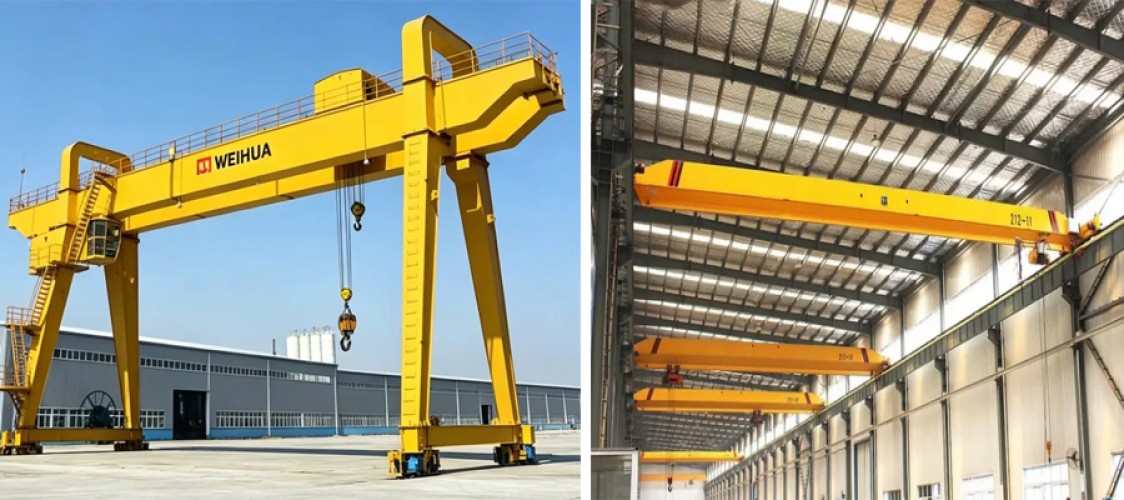
An overhead crane is a building-dependent piece of equipment with no ground legs. Its main beam spans across the overhead load-bearing beams and column rails on both sides of the factory, suspended entirely in the air. It relies on the factory’s steel structure or concrete columns to bear the full load. The crane travels back and forth on fixed overhead rails, occupying no ground space at all, making it a dedicated indoor lifting device.
15 Ton Overhead Crane With Hook.webp
Gantry Crane
A gantry crane can be seen as a modified version of the overhead crane. It has two vertical steel legs that form a stable gantry frame. The entire machine stands on its legs and runs on ground-mounted rails. It does not rely on the factory building and can operate independently, free from structural limitations, offering greater flexibility.
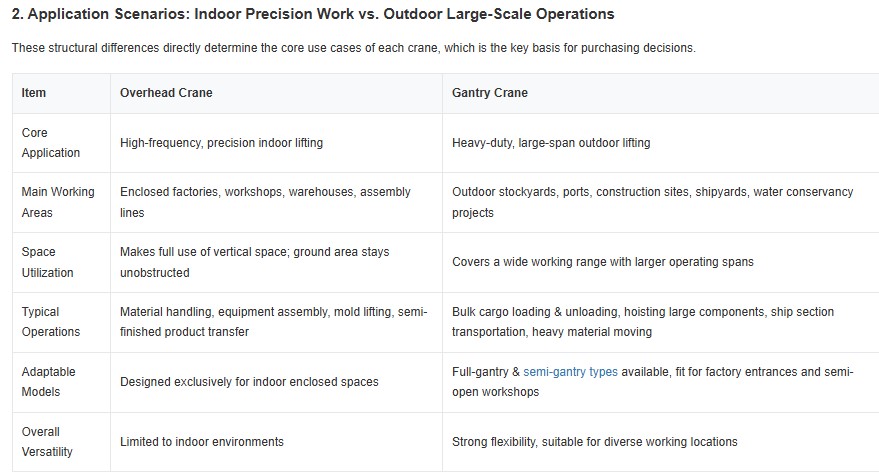
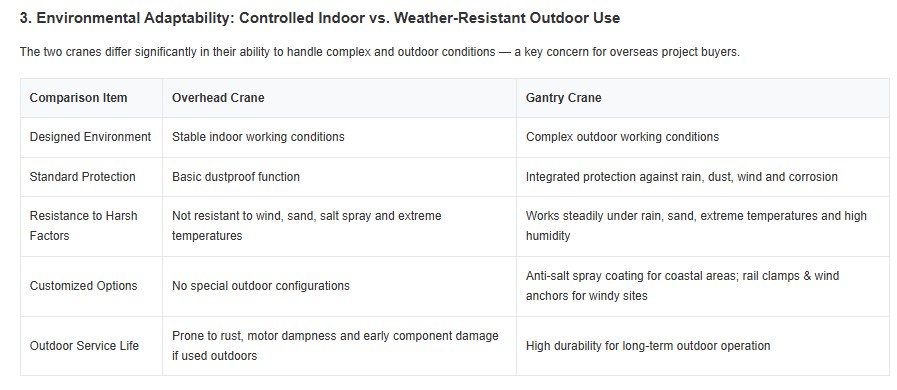
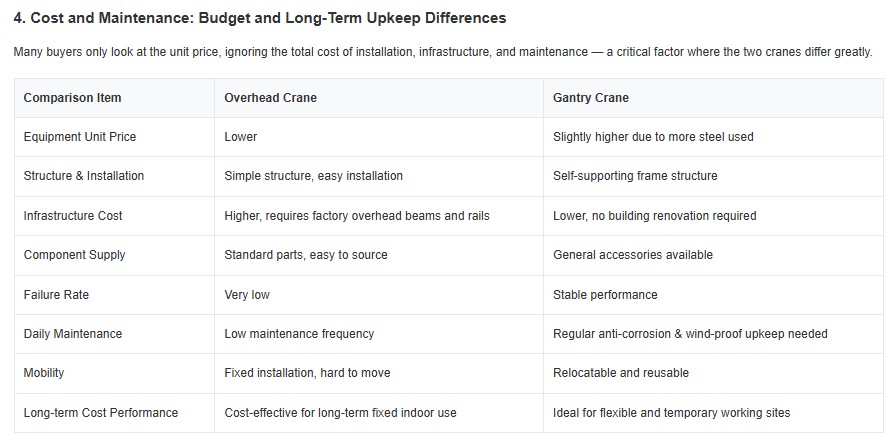
5. Quick Selection Guide: 10 Seconds to Choose the Right Crane
Based on years of experience with foreign trade projects, here’s a simple selection standard suitable for most domestic and international industrial projects:
Choose an overhead crane if you have:
A standard enclosed factory, mainly indoor assembly line work, a focus on precision and stability, long-term fixed-site production, and a budget focused on low long-term maintenance costs.
Choose a gantry crane if you have:
No dedicated factory building, operations in outdoor yards/ports/construction sites, need for large-span, wide-coverage lifting, flexible site use, or work in harsh outdoor conditions.
Conclusion
In short, the overhead crane is the first choice for precision indoor lifting, while the gantry crane is essential for heavy-duty outdoor operations. Neither is inherently better — the key is whether it matches your specific project conditions. If you are unsure which model suits your site and working conditions, feel free to contact us. With years of experience in crane customization and export, we can provide a one-on-one, free consultation to design the optimal lifting solution based on your environment, tonnage, span, and usage frequency, eliminating costly mismatches and ensuring stable, efficient equipment operation.
You can read the South Asia's famous agricultural magazine on
agricultural report through this link: https://gfmdhaka.com/
Source: Online/GFMM

















Copyright © 2026 LIMRA Exhibitions. All Rights Reserved.
Website Design & Development ♡ MY SOFT IT
 EN
EN
 Chinese
 Turkish
 Indonesian
 German
 French
 Spanish
 Portuguese
 Russian
 Italian